
Tear a freshly baked croissant in half and you will hear the crust crackle, see flakes tumble down, and catch a waft of buttery steam rising from the airy crumb. Behind that moment lies a whole night of work with dough, butter and temperature. Nhà An invites you behind the scenes of the bakery to find out why this little crescent has so many layers.
From the Crescent Roll to the Thousand-Layer Pastry
In French, croissant means crescent moon, just like the curved shape we know. Its ancestor is often said to be the kipferl, a crescent-shaped Austrian pastry. When Vienna-style bakeries appeared in Paris in the 19th century, the French gradually turned it into the laminated, butter-layered version we eat today. Because of this heritage, pastries like the croissant and pain au chocolat are called viennoiserie in French, meaning Vienna-style baked goods.
Plenty of colorful legends surround the croissant, but most are hard to verify. What we know for sure is the technique: croissants belong to the family of laminated yeast doughs, risen with yeast like bread and layered like puff pastry.
Lamination: The Secret Behind Dozens of Layers
Bakers call this step lamination. First, flour, yeast, sugar, salt and milk or water are kneaded into a dough, then left to rest in the cold. A piece of cold butter is rolled flat into a square slab and sealed inside the dough like a letter in an envelope.
Next, the dough is rolled out long and folded in three, chilled, then rolled and folded again. Each three-fold triples the number of butter layers. After three folds, the dough holds about 27 layers of butter between thin sheets of dough, all just a few centimeters thick.
- The butter must be cold but still pliable, about as soft as the dough; butter that is too hard will shatter, and butter that is too soft will soak into the dough and the layers will be lost.
- Between folds, the dough needs to rest in the cold so the gluten can relax and the butter can firm up again.
- More folds are not necessarily better: if the butter layers get too thin they will tear, and the pastry loses its flaky separation.
Proofing and Baking: Yeast Lifts, Steam Separates
After lamination, the dough is cut into long triangles, rolled from the base to the tip and placed on a tray. Proofing needs a moderately warm spot: warm enough for the yeast to work and release gas that puffs the pastry up, but not so hot that the butter melts out. A croissant is properly proofed when it has grown noticeably, the layers show at both ends, and it jiggles gently when you shake the tray.
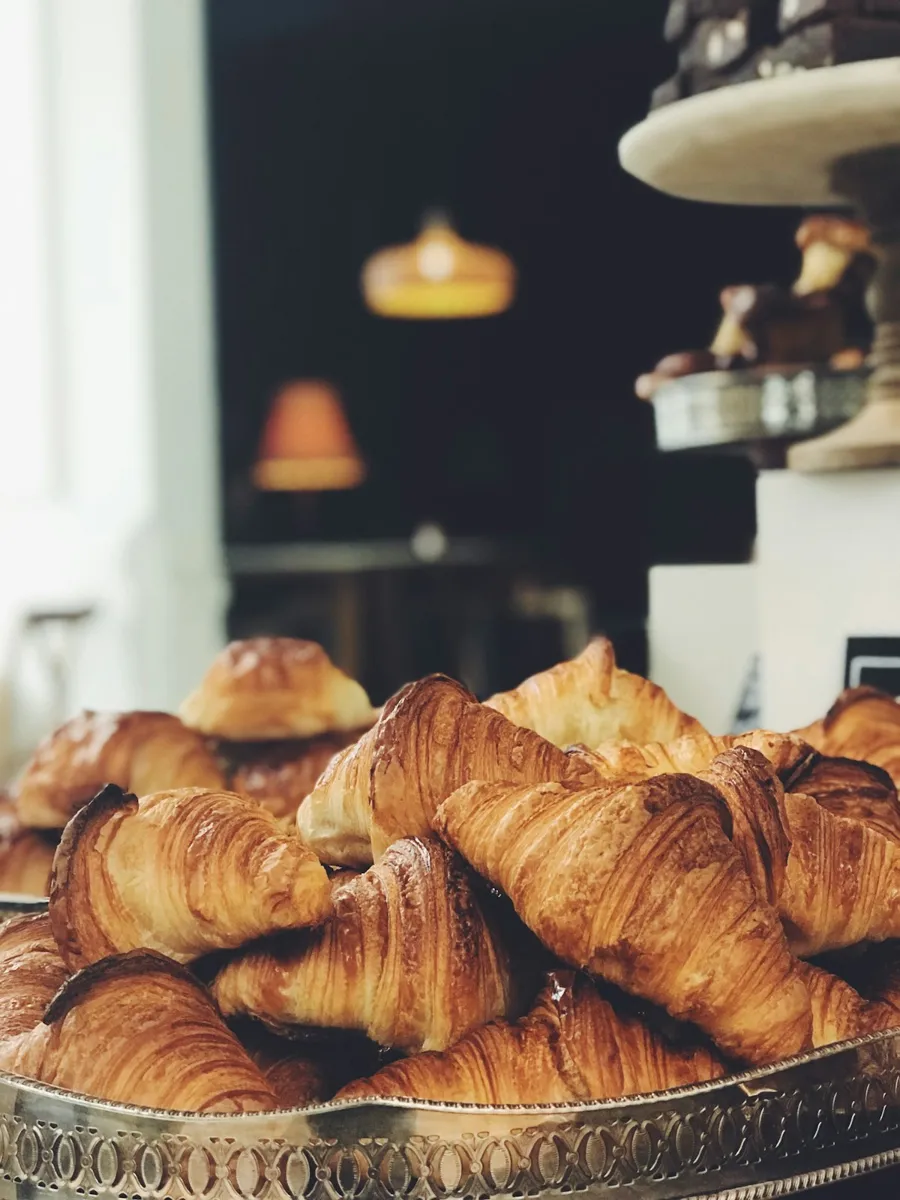
Before going into the oven, the pastries are usually brushed with a thin coat of egg wash for a glossy golden crust. Then, in the hot oven, the magic happens: butter is about 80% fat, and most of the rest is water. That water turns to steam and pushes the layers of dough apart, while the fat keeps them from sticking back together. So a croissant rises from the yeast and puffs from the steam, giving a paper-thin crisp crust and an airy, honeycomb crumb.
Flour, butter and time: take away any one, and the pastry loses all its layers.
Choosing a Good Croissant and Reheating It Crisp
You do not need to be a baker to spot a well-made croissant. A few small signs will tell you:
- An evenly golden-brown crust with clearly defined spirals, and no burnt ends.
- It feels light for its size, because the crumb is full of air pockets.
- A gentle squeeze gives a crisp crackle, and a few falling flakes are perfectly normal.
- A cross-section shows a honeycomb crumb with thin, distinct layers; a dense crumb like ordinary bread usually means the butter melted during lamination or proofing.
- The bottom is dry and not greasy, with a mild buttery aroma.
A croissant is best on the day it is baked. If you buy one for the next day, keep it in a sealed bag at room temperature; to keep it longer, freeze it, since the refrigerator dries and hardens pastry faster. To eat, reheat it in the oven at about 160-180°C (320-355°F) for 3-5 minutes, or in an air fryer for a shorter time, and the crust will turn crisp again. A microwave is fast but usually leaves the pastry limp and chewy.
Croissant and Wood-Fired Oolong: A Morning Pair
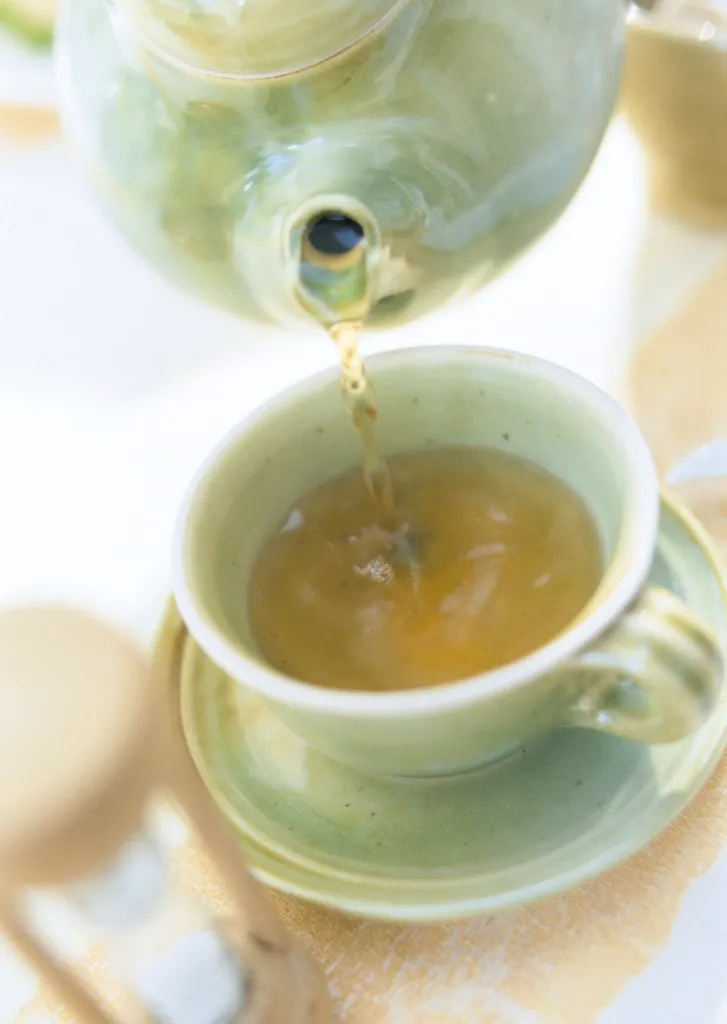
A croissant is rich and buttery, so it calls for a drink that lightens the palate after each bite. A cup of hot wood-fired roasted oolong does just that: the roasted aroma, notes of honey and a faint whisper of wood smoke blend with the baked butter, while the tea's gentle astringency cuts the richness so the next bite tastes as fragrant as the first. If you prefer something cold, an iced oolong with little sugar is also a refreshing choice for an early, sunny morning in Saigon or Da Nang.
The Nhà An Bakery: Fires Lit from 5 A.M.
When Nhà An opens, the ovens at every branch will start baking at 5 a.m., while the streets are still asleep. Our croissants are made with flour and cultured butter, a butter churned from lightly fermented milk cream, which gives a deep aroma and a gentle tang that goes beautifully with the roasted notes of oolong. The pastries are baked fresh each day, so whether you are pulling an all-nighter on a deadline or stopping by early before work, a warm croissant will be waiting.
Like everything at Nhà An, the pastries are vegetarian. Our croissants contain butter, milk and eggs; if you eat vegan, egg-free and dairy-free items are labeled separately at the counter. If you have a gluten, dairy or egg allergy, please tell our staff before choosing a pastry.
Read moreVisit the Nhà An bakery